

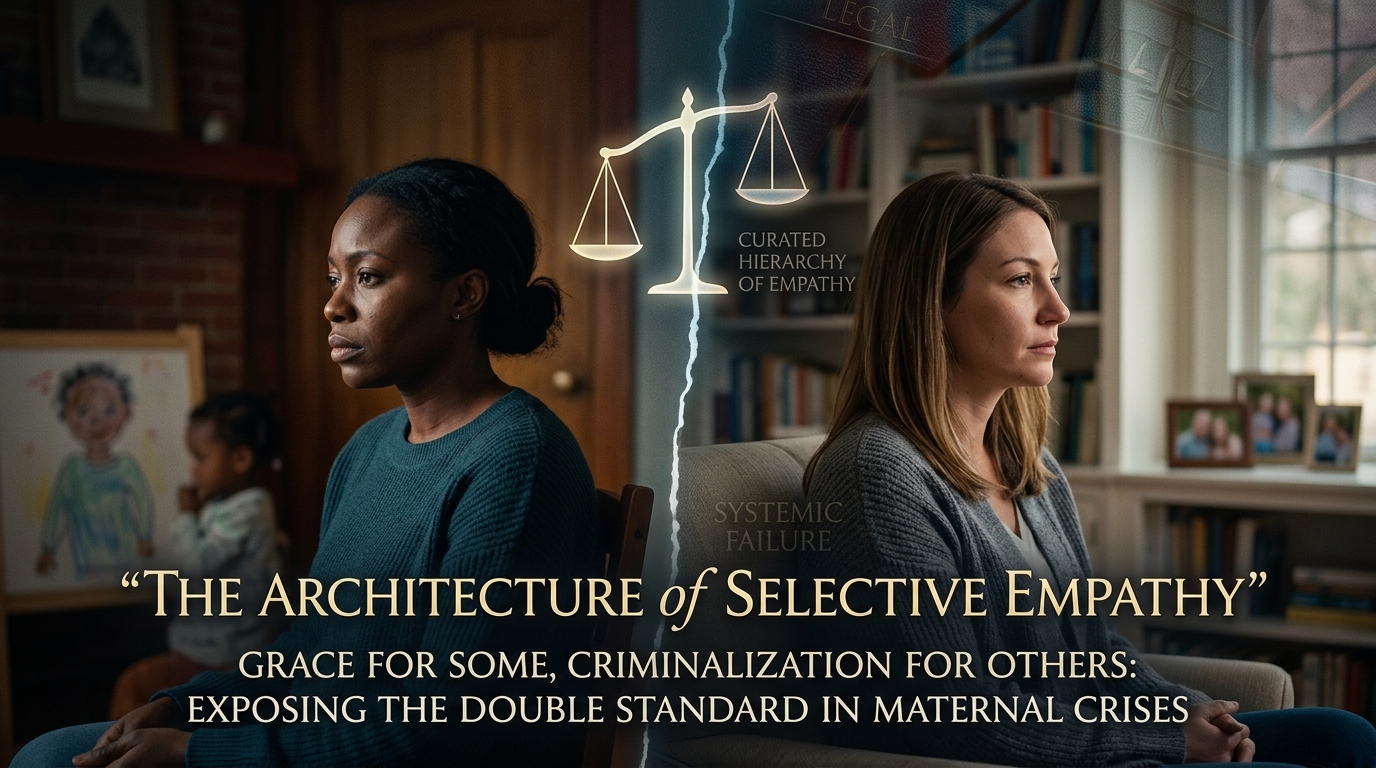
As a woman with what society labels “light-skin privilege,” I have spent a lifetime oscillating between two worlds. That vantage point gives you an unobstructed view of how systemic empathy actually functions. You see firsthand how different groups perceive themselves and each other: one demographic conditioned to believe they can do no wrong and that the world owes them comfort, and another deeply burdened by historical trauma, fighting the feeling that everyone has done them wrong.
Living in that middle space forces you to notice the stark contradictions in how society assigns victimhood, power, and humanity.
The Paradox of Victimhood vs. Authority
Notice the contradictory narrative constructed around white womanhood in America. On one hand, mainstream media consistently positions white women as the universal faces of domestic violence, human trafficking, and fragile vulnerability—the archetypal victims who are naturally weak, meager, and owed immediate protection. On the other hand, the exact same demographic is simultaneously positioned as inherently more educated, refined, and fit for institutional authority and leadership.
They get to occupy both spaces at once: the innocent victim entitled to endless grace, and the competent authority entitled to power.
Meanwhile, women of color who experience trauma are almost never afforded the luxury of fragile innocence. When marginalized women attempt to access crisis shelters, they are routinely turned away, told funding is exhausted, or subjected to bureaucratic surveillance that treats their crisis as personal neglect.
Yet, when prominent white survivors speak out, they are quickly handed platforms, public funding, book deals, and collaborative partnerships with law enforcement—even while simultaneously critiquing those very systems without facing professional ruin. When survivors of color try to organize in underfunded environments, artificial scarcity forces people into toxic gatekeeping, infighting, and colorism—replicating the very bully tactics and power hoarding of the institutions that failed them in the first place.
A Tale of Two Mothers: Lisette Baminga vs. Lindsay Clancy
Nowhere is this dynamic of selective empathy more glaring than in how our justice and medical systems respond to extreme maternal psychiatric crises.
Consider the stark contrast between two cases involving severe postpartum illness:
| Factor | Lisette Baminga (2012) | Lindsay Clancy (2023) |
| Demographics & Background | Black, immigrant mother from the Democratic Republic of the Congo living in New York. | White, suburban mother and labor/delivery nurse living in Duxbury, Massachusetts. |
| Medical / Clinical Context | Experienced severe postpartum distress, diagnosed with severe postpartum depression and psychosis; sought psychiatric care prior to the event. | Treated extensively for postpartum anxiety/depression; prescribed a cocktail of up to a dozen psychiatric medications over a short window. |
| The Event | Poisoned and drowned her two young children (4-month-old daughter and 4-year-old son); attempted suicide by turning on the gas stove and slashing her wrists. | Strangled her three children; attempted suicide by jumping from a second-story window. |
| Legal Strategy & Defense | Sought a defense of Not Guilty by Reason of Insanity (NGRI) based on severe acute psychosis and hallucination. | Defense argued acute psychosis induced or exacerbated by overmedication and systemic failure of maternal psychiatric care. |
| Public & Media Framing | Framed primarily as a severe criminal act; received limited mainstream sympathy and minimal national discourse on systemic healthcare gaps. | Sparked massive public dialogue, GoFundMe campaigns raising hundreds of thousands of dollars, and widespread empathy regarding postpartum psychosis. |
Systemic and Social Patterns
1. Disparities in Public Empathy and Institutional Humanity
-
The Benefit of the Doubt: When white, affluent women experience severe postpartum psychiatric crises, public discourse frequently shifts toward clinical framing—viewing the individual as a victim of a broken medical system, overmedication, or overwhelming illness.
-
Criminalization Over Medicalization: Women of color, particularly immigrant women or those without socio-economic privilege, are far more frequently viewed through a lens of criminality, culpability, or maternal failure, with their psychiatric history often marginalized during legal proceedings and public reporting.
2. Access to Care and Shelter Disparities
-
Resource Access: The broader infrastructure supporting women in crisis—from specialized psychiatric maternal wards to emergency shelters—often exhibits significant racial and socio-economic inequities.
-
Shelter Disparities: Studies of intake systems consistently show that low-income women of color face higher rates of diversion, stringent eligibility criteria, and administrative hurdles when seeking emergency housing, whereas private resources, legal advocacy networks, and well-funded non-profit partnerships are less accessible to marginalized communities.
3. Institutional Coalitions and Advocacy Gatekeeping
-
Platforming & Advocacy: High-profile cases involving affluent survivors often generate partnerships with law enforcement reform groups, legislative advocacy, and well-funded survivor foundations.
-
Intra-Community Tensions and Resource Competition: When resources are scarce, non-profit systems can foster gatekeeping, where access to aid or visibility is strictly controlled, sometimes replicating systemic biases regarding who is deemed “deserving” of support and protection.
The Law Reflects the Culture
This cultural double standard is not an accident; it is codified directly into our legal architecture through landmark Supreme Court rulings:
-
⚖️ McCleskey v. Kemp (1987): The Supreme Court explicitly recognized that statistical racial disparities exist throughout the criminal justice system, but ruled that systemic disparity alone is not enough to prove a constitutional violation without individualized proof of malice. In doing so, the Court normalized systemic inequality as an acceptable status quo.
-
⚖️ Castle Rock v. Gonzales (2005) & DeShaney v. Winnebago County (1989): The Court affirmed the “public duty doctrine,” establishing that police and the state have no constitutional duty to protect citizens in crisis. This shields institutions from liability when they fail vulnerable people, leaving marginalized individuals with no legal guarantee of safety while state actors maintain wide latitude and qualified immunity.
Is This Who We Are?
When the law accepts disparities (McCleskey) and absolves institutions of their duty to protect (Castle Rock), empathy becomes a commodity distributed by race, class, and proximity to privilege.
Advocacy from marginalized communities is not about asking to excuse horrific acts, nor is it about dismissing the medical reality of postpartum illness. It is about exposing a two-tiered framework where one group receives medical understanding, institutional grace, and structural excuses, while everyone else is met with surveillance, criminalization, and collective blame.
Until society and the legal system apply the exact same standard of humanity, intervention, and nuance to a Lisette as they do to a Lindsay, we do not have a justice system—we have a curated hierarchy of empathy.